
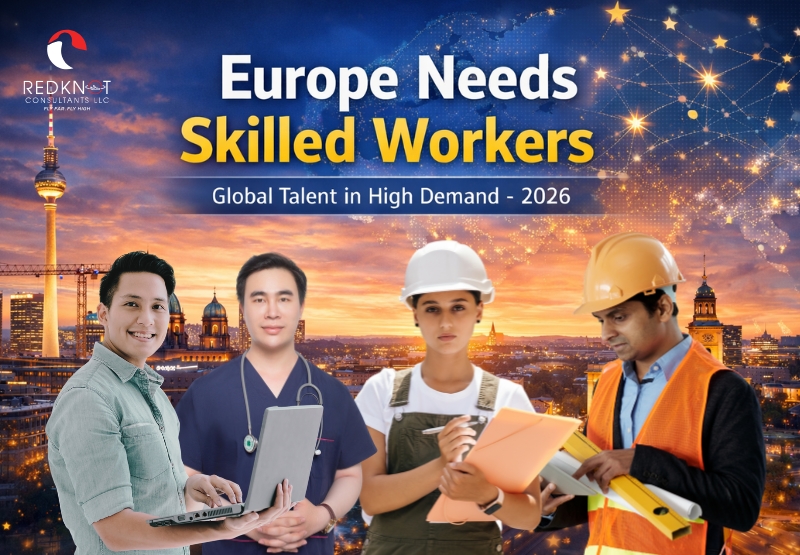
If you're a skilled professional in India considering international opportunities, Europe's skill shortage has never been more severe — or more welcoming to global talent. As we move through 2026, European nations are facing critical workforce gaps that domestic populations simply cannot fill, opening unprecedented pathways for qualified workers from around the world.
The Scale of Europe's Labour Crisis
Europe labour shortages have reached crisis levels across the continent. According to the European Commission, 4 in 5 businesses struggle to find workers with the right skill set — a staggering statistic that affects everything from healthcare to construction.
Germany alone faces 600,000+ blue-collar vacancies and shortages in 163 occupations
EU job vacancy rate: 2.3-3% across member states
62% of organizations report significant skills gaps
Italy plans to welcome 500,000 new workers from outside the EU between 2026-2028
High-Demand Sectors
The European Labour Authority has identified shortages in 42 occupation types, with the most critical gaps in:
Why Europe Faces This Crisis
Multiple factors converge to create Europe's skill shortage:
Aging Population Over 27% of Europeans will be past retirement age by 2030. The workforce is shrinking while healthcare and service demands increase.
Low Birth Rates Declining birth rates across EU nations mean fewer young workers entering the labor market to replace retirees.
Technological Transformation Rapid digital and green transitions require new skills that traditional education systems haven't produced fast enough.
Pandemic Aftermath COVID-19 disrupted training programs, caused career shifts, and created pent-up demand as economies reopened.
Skills Mismatch Education systems focus on theoretical knowledge while employers need practical, industry-specific expertise.
The result? 70% of organizations report that Europe labour shortages are causing recruitment challenges and stifling innovation.
New Immigration Policies Opening Doors
Facing economic pressure, European governments have dramatically reformed immigration policies to attract skilled workers:
Germany's Opportunity Card (Chancenkarte)
A points-based entry system allowing skilled workers to enter Germany for job searching, even without a job offer. Points awarded for qualifications, experience, age, and German language skills.
EU Blue Card Reforms
For shortage occupations, the EU Blue Card now requires a lower salary threshold of €45,934 annually (2026) instead of the standard threshold. Processing is faster with Federal Employment Agency approval.
"Choose Europe" Campaign
Launched March 2026, this EU initiative simplifies work visa applications, expands programs like Erasmus+, and actively recruits foreign professionals.
Skills Union Initiative
- Education and training upgrades
- Professional retraining programs
- Mobility programs for workers
- Streamlined visa processes for non-EU skilled professionals
Sectors Hiring International Talent in 2026
Healthcare
Nurses, allied health professionals, and care workers face the highest demand. Most roles require B1-B2 local language proficiency but offer strong salary packages (€35,000-€65,000 annually) and permanent residency pathways.
Engineering & Construction
Civil engineers, mechanical engineers, electrical engineers, welders, plumbers, and construction managers are critically needed for Europe's Green Deal infrastructure projects. Salaries: €45,000-€85,000 annually.
Information Technology
Software developers, cybersecurity specialists, data scientists, and ICT business analysts can earn €50,000-€90,000 annually with fast-track immigration options.
Skilled Trades
Electricians, carpenters, bricklayers, auto mechanics — manual trades face severe shortages with vacancy rates of 3.4% in construction vs 2.9% in services.
Transport & Logistics
Truck drivers, warehouse managers, logistics coordinators needed across the EU. Salaries: €30,000-€55,000.
Education
Secondary school teachers, early childhood educators, and STEM instructors in high demand. Requires local qualifications but offers permanent pathways.
What Indian Professionals Need to Know
Europe's skill shortage creates real opportunities for qualified Indian workers, but success requires:
Each EU nation has different rules. Germany, Netherlands, Sweden, and Portugal offer the most streamlined pathways for skilled workers.
English works in many IT roles, but B1-B2 local language (German, French, Dutch) significantly improves prospects, especially in healthcare and trades.
Engineering, healthcare, and trade qualifications often require evaluation by European authorities. Start this process early — it can take 3-6 months.
Check Germany's Shortage Occupations List, France's Métiers en Tension, and Netherlands' Shortage List to confirm your occupation qualifies.
Most skilled worker visas require minimum salaries (€35,000-€55,000 depending on country), though shortage occupations have lower thresholds.
Long-Term Benefits for Skilled Workers
Long-term contracts, strong labor protections, 25-30 days annual leave
Spouses can work, children access free education, family reunification after 1-2 years
Most countries offer PR pathways after 3-5 years of work
Healthcare, unemployment insurance, pensions included
After PR, live and work anywhere in the EU
Ready to Explore Europe's Growing Opportunities?
RedKnot Immigration has 12+ years of experience helping Indian professionals secure EU Blue Cards, Europe work permits, and permanent residency pathways. We guide you through:
- Occupation assessment and country matching
- Document preparation and credential evaluation
- Work visa applications and Blue Card processing
- Job search support and employer connections
- Settlement services and family reunification
Contact RedKnot
📍 Deira Twin Towers (Rolex)
Invox Business Center
Office No: 35, Level 12, Deira
PO Box: 231381, Dubai, United Arab Emirates
📧 Contact via red-knot.com
12+ Years Experience
Schedule your free consultation today and turn Europe's skill shortage into your career opportunity.
Frequently Asked Questions
Engineering: €45,000-€85,000
IT: €50,000-€90,000
Skilled Trades: €35,000-€60,000
Education: €35,000-€55,000
Salaries vary by country, experience, and qualifications.