
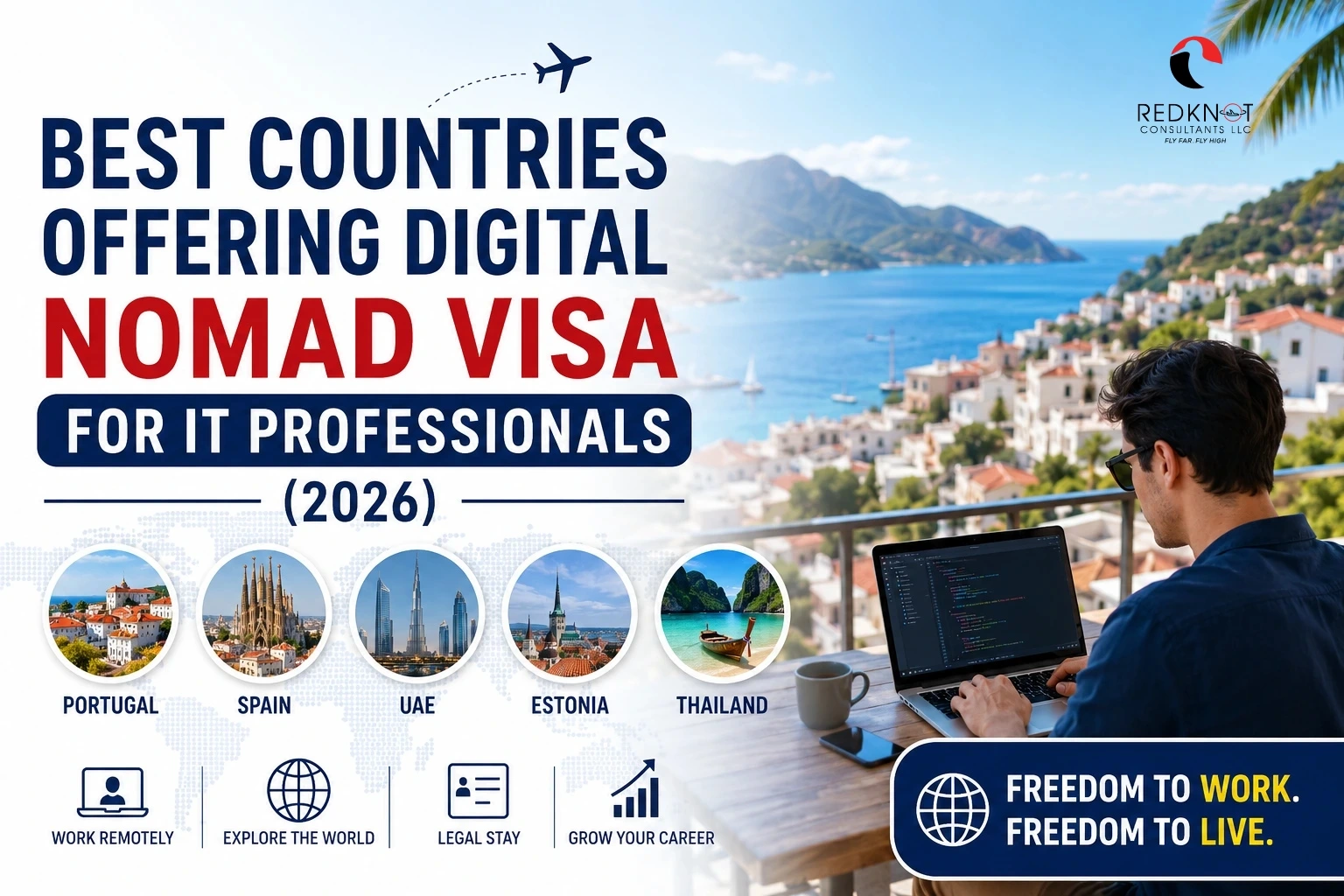
Something shifted in the global tech workforce after 2020 — and in 2026, it hasn't shifted back. Indian IT professionals, software developers, cybersecurity analysts, and freelance tech consultants are no longer tied to office desks or even their home countries. More than 35 million people now identify as digital nomads globally, and IT professionals make up a significant and growing share of that number.
The reason is straightforward. Tech work is location-independent, well-compensated, and increasingly accepted by employers and clients on a remote basis. The question isn't whether you can work from anywhere — it's which country's digital nomad visa for IT professionals gives you the best combination of cost, lifestyle, legal clarity, and career opportunity. This guide covers exactly that.
A digital nomad visa (DNV) is a special-category residence permit that allows foreign nationals to live in a country legally while continuing to work remotely for employers or clients outside that country. Unlike a tourist visa, it's designed for medium-to-long stays — typically 6 months to 2 years. Unlike a work visa, it doesn't require a local employer to sponsor you.
In 2026, over 60 countries have active digital nomad visa programs. Each has its own income threshold, application process, and eligibility conditions. Some are straightforward. Others have requirements — like the UAE's recent move to require 6 months of bank statements rather than 3 — that catch applicants off guard if they haven't done their homework.

In 2026, Spain has issued over 32,000 digital nomad visas since its program launched — applications are up 40% year on year. Portugal's D8 visa waitlists have grown significantly. The UAE's remote work program sees consistent demand from Indian IT professionals relocating from Gulf employment to freelance setups. The trend is driven by three things: employers embracing permanent remote work, tech salaries enabling affordable relocation, and governments actively competing for digital nomad income and economic activity.
No grey area tourist visa overstays — a proper DNV gives you legal residence status
Countries like Portugal and Croatia rank among the highest globally for quality of life, safety, and outdoor lifestyle
Spain offers a 15% flat income tax rate for DNV holders under certain conditions. Georgia offers zero income tax on foreign earnings. Always verify with a tax professional
Established nomad communities in Lisbon, Tallinn, Chiang Mai, and Kuala Lumpur give IT professionals access to international developer meetups, startup events, and co-working communities
In Malaysia and Thailand especially, a tech salary that's modest by European or UAE standards supports a very comfortable lifestyle
Several programs (Portugal, Spain, Estonia) offer pathways from DNV to long-term residency and potentially citizenship
Income requirement: €3,680/month (updated for 2026 — four times Portugal's minimum wage). Duration: 1 year, renewable for 2 years. Portugal has one of the most established nomad ecosystems in Europe — Lisbon, Porto, and Madeira all have active co-working and expat communities. After 5 years, residents can apply for Portuguese (EU) citizenship. English is widely used in cities.
Income requirement: approximately €2,334/month. Duration: 1 year, renewable up to 5 years. Spain's program (part of the Startup Act) offers a flat 15% income tax rate for the first four years — significant savings for mid-to-high income IT professionals. Cities like Barcelona, Valencia, and the Canary Islands are popular. Applications are up 40% in 2026.
No fixed minimum income requirement, but applicants must demonstrate stable employment and now need 6 months of bank statements (updated January 2026). Tax-free income. World-class infrastructure. The UAE Remote Work Visa is particularly relevant for Indian IT professionals already based in the Gulf who want to formalise their remote working arrangements. Duration: 1 year, renewable.
Income requirement: approximately €3,504/month. Estonia pioneered the world's first digital nomad visa in 2020 and pairs it with a unique e-residency program that lets you register an EU-based company entirely online. Ideal for freelance developers, IT consultants, and startup founders who want a base in the EU with full digital governance.
Income requirement: $27,000/year (or $80,000 assets). Duration: 10 years. Thailand doesn't have a traditional DNV but the LTR Visa for digital workers effectively serves the same purpose at scale. Chiang Mai is globally recognised as one of the most established digital nomad cities — affordable, connected, and with a large English-speaking community of tech workers.
Income requirement: approximately €2,540/month. Duration: 1 year (not renewable — must leave and reapply). Croatian cities like Split, Zadar, and Zagreb offer Adriatic lifestyle at significantly lower cost than Western Europe. Particularly popular with remote workers who want EU time zones without EU Western Europe price tags.
Germany doesn't have a dedicated DNV but the Freiberufler (freelancer) visa is available to IT professionals. Income requirements vary; integration into Germany's tech market is the main draw — access to one of Europe's largest developer ecosystems and some of the highest tech contractor rates in the EU.
Income requirement: $24,000/year for tech professionals ($60,000 for non-tech). Duration: 3–12 months, renewable. Kuala Lumpur has emerged as a serious tech hub in Southeast Asia — infrastructure is strong, English is widely used in professional contexts, and the cost of living is significantly below Thailand or Singapore at comparable quality.
| Country | Min. Income | Duration | Tax Benefit | Cost of Living | Best For |
|---|---|---|---|---|---|
| Portugal | €3,680/mo | 1+2 yr | Moderate | Medium | EU residency path |
| Spain | €2,334/mo | Up to 5 yr | 15% flat tax | Medium | Lifestyle + tax |
| Dubai/UAE | Show stable income | 1 yr | Zero tax | High | High earners |
| Estonia | €3,504/mo | 1 yr | E-residency | Medium | Startup founders |
| Thailand | $27,000/yr | 10 yr LTR | Limited | Low | Long-term, budget |
| Croatia | €2,540/mo | 1 yr | Limited | Low-Med | EU lifestyle, budget |
| Malaysia | $24,000/yr | Up to 1 yr | Limited | Low | Asian tech hub |
Estonia (e-residency + EU company), Portugal (strong developer community), Malaysia (affordable with growing tech scene)
UAE (high-demand sector, tax-free), Germany (EU enterprise market access)
Portugal and Spain (strong creative communities), Thailand (affordable, good internet)
Estonia (e-residency for invoicing), Croatia (affordable EU base, strong internet)
Spain (Spanish-speaking market access), Malaysia (Southeast Asian digital economy)
For most Indian IT professionals working remotely for US, EU, or UAE-based companies, a DNV is the appropriate route. A traditional work visa is only needed if you're taking local employment in the host country.
Freelancers with irregular income or multiple clients can struggle to meet the 'minimum monthly income' threshold in a way that satisfies consular officers. Bank statements, client contracts, and invoicing history are all helpful here
Many applicants don't understand that physical presence in a country for 183+ days typically triggers tax residency, regardless of where your income comes from. Get tax advice before relocating
Some employers resist providing formal remote work authorisation letters. Resolve this with your employer before applying
Common reasons include incomplete documentation, income below threshold, and unclear purpose of stay. Professional application support significantly reduces this risk
Red Knot's migration team works specifically with Indian professionals — both those based in India and those currently in the Gulf — who are looking to formalise their remote working arrangements abroad. They provide:
Matching your income, employer situation, and lifestyle priorities to the program most likely to be approved
Income documentation, employer letters, bank statement formatting, and certified translations
Filing directly with the relevant consulate or immigration authority
Arrival registration, tax residency planning referrals, and renewal guidance
Red Knot's immigration consultants are ready to guide you from first question to final approval.
It depends on what you're optimising for. For EU residency pathway: Portugal. For tax savings: Spain or UAE. For affordability: Malaysia or Thailand. For startup founders: Estonia. For Indian IT professionals in particular, the UAE Remote Work Visa deserves serious consideration given proximity, time zone alignment with Indian clients, and zero income tax.
Yes — Indian passport holders are eligible for digital nomad visa programs in most countries that offer them, including Portugal, Spain, Estonia, Croatia, Thailand, and Malaysia. The UAE Remote Work Visa is specifically popular with Indian professionals already in the Gulf. Eligibility depends on income, documentation, and employer circumstances — not nationality restrictions.
It varies significantly. Malaysia's DE Rantau requires $24,000/year (~$2,000/month) for tech professionals. Spain requires around €2,334/month. Portugal requires €3,680/month (updated 2026). Estonia requires approximately €3,504/month. The UAE has no fixed threshold but expects demonstrated stable income and 6 months of bank statements. Indian IT professionals with US or EU clients typically meet most thresholds comfortably.
Malaysia's DE Rantau program has relatively straightforward requirements for tech professionals and a simpler application process than many EU programs. For Indian applicants, the UAE Remote Work Visa is also accessible — particularly for those already holding UAE residency who want to transition to a freelance or remote setup.
No — the visa itself doesn't determine your tax status. Spending 183+ days in a country typically triggers tax residency there, regardless of what the visa says. Some countries offer favourable tax treatment for DNV holders (Spain's 15% flat tax, UAE's zero income tax), but this is a country-specific tax regime, not a feature of DNV programs in general. Always take qualified tax advice before relocating on a DNV.
The best digital nomad visa for IT professionals in 2026 isn't a single answer — it's the country that matches your income, your career goals, your family situation, and your lifestyle priorities.
Start by being honest about what matters most to you: tax savings, EU residency pathway, cost of living, time zone alignment with your clients, or community. Then match that to a program where your income and documentation profile is a clean fit.
Red Knot's migration team has specific experience advising Indian IT professionals on digital nomad visa applications. Get in touch at +971 50 580 8944 or info@redknot.ae to discuss your situation.
Red Knot's immigration consultants are ready to guide you from first question to final approval.